Showing posts with label photos. Show all posts

Sunday, August 9, 2009

Archive of Images from the Late 19th Century Jesup Expedition to the Northern Pacific


From the American Museum of Natural History, Photographs from the Jesup North Pacific Expedition (1897-1902):
The Jesup North Pacific Expedition led by Franz Boas, the first landmark research project of the Division of Anthropology, turned out to be one of the most scientifically important anthropological investigations ever mounted. Conceived and directed by Franz Boas, the expedition was financed by Museum president Morris K. Jesup. The Expedition was concerned with the extent and nature of contact between the tribes of the Northwest Coast and Siberia with an eye to solving the problem of the origin of the first populations to inhabit the New World.

Under the auspices of the Jesup North Pacific Expedition, described as the "foremost expedition in the history of American anthropology" (Freed and Freed 1988: 7), Berthold Laufer, Waldemar Jochelson, and Waldemar Bogoras conducted ethnographic research and made collections in the Siberia, Manchuria, and on Sakhalin Island. Laufer worked among the Nivkhi (Gilyak), Evenk, and Ainu on Sakhalin Island and the Nanai (Golde) of the Amur River. Bogoras studied the Chukchi and Yupik (Siberian Eskimo), and Jochelson the Koryak, Yukaghir, and Sakha (Yakut).

[Above is a photograph of Russian exiles in Siberia; Below is an original map created by Franz Boas depicting the areas covered by the Jesup expedition.]

Archive of Early 20th Century Photos from the Congo

From the American Museum of Natural History, Photographs from Lang-Chapin Congo Expedition (1909-1915):
Between 1909 and 1915 Mammalogist Herbert Lang (1879-1957) with assistant James P. Chapin (1889-1964) led the Congo Expedition. The two scientists collected and documented zoological, botanical, and anthropological collections and produced painted and photographic images of the natural and human environment.

The anthropological aims of the expedition initially focused on three matters:
- finding out about the Pygmies, at the time still regarded as one of Africa's greatest curiosities;
- gathering information about the physical types of various peoples;
- collecting ethnographic materials illustrative of all aspects of culture.

For Lang, ethnographic objects were clues to deciphering the culture code. A description of a knife would lead to a discussion of how fields were cleared, the division of labor, or the ceremonial uses of knives. A photograph of a chief or a ritual specialist would lead to an interview with the person and a brief description of that person's life history.


To see the entire collection, just leave the search option blank and click 'search'. [via Boing Boing, via Clayton Cubitt]

Wednesday, March 18, 2009

These are your pictures. You should be able to see them.

[Masks worn during experiments with Plague. Philippines, probably around 1912]

Mike Rhode, the head archivist at the National Museum of Health and Medicine in Washington, D.C. is beginning to make a huge archive of military medical imagery available online (through flickr). The archive consists of over 500,000 images (that have thus far been scanned) of medical images from the Civil War to Vietnam. They are slowly but surely getting them online for the rest of us, on their own time [from Wired]:
The organization that runs the NMHM — the Armed Forces Institute of Pathology, funded by the Department of Defense — hasn't signed off on Rhode's plan to bring medical history photos to the people.

"The Army does not appreciate people using Army resources for sites that they don't consider to be related to your job," Rhode said. Flickr, like many social media sites, is blocked by the Army.

Still, Rhode is continuing to push to get the photos, a precious resource, into the light of the internet.

"We have pictures from all types of military conflicts and all different types of medicine and issues in medicine," Rhode said. "We love the stuff that we're able to play with and want to bring it to everyone else in the world."

The Library of Congress also has vast archives (though again, only a fraction of their materials are online) and has started placing things on flickr as well. [Though you can find even more in the archives on their own site]
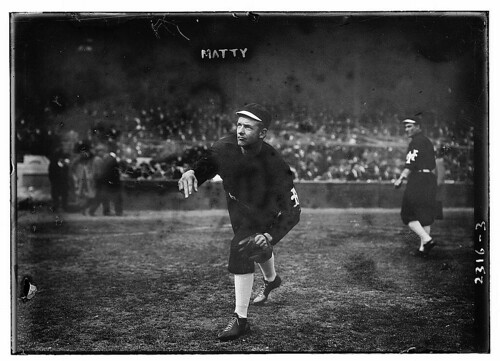
[Christy Mathewson, warming up before pitching in the World Series, 1911]