To be hopeful in bad times is not just foolishly romantic. It is based on the fact that human history is a history not only of cruelty but also of compassion, sacrifice, courage, kindness. What we choose to emphasize in this complex history will determine our lives. If we see only the worst, it destroys our capacity to do something. If we remember those times and places--and there are so many--where people have behaved magnificently, this gives us the energy to act, and at least the possibility of sending this spinning top of a world in a different direction. And if we do act, in however small a way, we don't have to wait for some grand utopian future. The future is an infinite succession of presents, and to live now as we think human beings should live, in defiance of all that is bad around us, is itself a marvelous victory,"
In this big dramatic production that didn't do anyone any good (and was pretty embarrassing, really, if you think about it), thousands upon thousands of phonies across the country mourned the death of author J.D. Salinger, who was 91 years old for crying out loud.
“Salinger had remarked that he was in this world but not of it,” the statement said. “His body is gone but the family hopes that he is still with those he loves, whether they are religious or historical figures, personal friends or fictional characters.”
This an album of recordings made by Gershon Kingsley in the late 60s and early 70s, being reissued by Reboot Stereophonic, a label that puts out vintage Jewish music.
God is a Moog:
For those few suffering music fans who don't immediately think of Kraftwerk-esque electronica when they hear melodic Jewish liturgy, treatment is now available by mail-order. God Is a Moog is a double album featuring recordings from 1968 to 1974, in which pioneering musician, and Moog keyboard innovator, Gershon Kingsley attempted to fuse the machine and the divine. Using his creativity, the Moog, and a few choice Proverbs, Kingsley recorded everything from meditations on identity and freedom, to a rock opera for the Sabbath (written to include a gospel choir). Be warned, the album is as infectious as it is intelligent, which is to say, it just might blow your mind. In addition, you, who have previously been described as "endearingly awkward and strangely moving," might be interested to know that the very same words were used by Time Out New York to describe God Is a Moog. Though, Time Out also called it an example of "radical Jewish culture decades before John Zorn coined the term," and that bit doesn't sound like you at all. Find out more about Robert Moog, the visionary who invented the Moog Synthesizer.
In honor of the holiday season, we are proud to offer this little mix of music culled from our various albums, archives and projects. There's plenty of choice old-school tracks mixed in with new school Idelsohn exclusives like the re-mix of the Yemenite Trio by Soulico's DJ Sabbo. Songs from Lionel Hampton and Marlena Shaw are just a taste of what's to come on our next release forthcoming in 2010, Black Sabbath, an homage to the musical history of Blacks and Jews. Of course, there's also a couple of classic Christmas anthems courtesy of that other tradition's most beloved holiday crooners, Barbra and Neil.
Track list: "The Problem"- Ray Brenner & Barry E. Blitzer "White Christmas"-Barbra Streisand "Dreidel, Dreidel, Dreidel"- Ella Jenkins "Hava Nagila"- Lionel Hampton "Mizrachi on the Drums (Sabbo Remix)"/"Seeing Israel"- The Yemenite Trio Vs. George Jessel "Kale Kale"- Avram Grobard "Holiday Mambo"- Machito & His Afro-Cubans "They're Serving the Fish"- Benny Bell & The Brownsville Klezmers "Blue"/"Santa Claus"- King Midas Sound vs. Ray Brenner & Barry E. Blitzer "Where Can I Go?"- Marlena Shaw "The Jewish Experience (MIS Remix)"/ "In The Beginning"- Gershon Kingsley vs. Charlton Heston "Songs My Mother Loved"- Milton Berle "That Old Black Magic"- Johnny Mathis "Loco"- Don Tosti "Have Yourself A Merry Little Christmas"- Neil Diamond "Hanukkah Dance"-Woody Guthrie
Our old friend, Bruce Katz, has an interesting article written with Jennifer Bradley in the New Republic about my favorite city that I've never been to: Detroit. It imagines (naturally) the future Detroit, and gives some broad examples of what can be done to keep the city moving forward; interestingly, it compares it to other cities that have suffered over the last 30 years form the decline of the auto industry- Turin, Italy; Akron, and Toldeo, Ohio- that have rebuilt themselves and their employment base to some extent. It also mentions Bilbao, Spain, which revitalized itself in ways that are go beyond the building of the Guggenheim Museum there. The economy os only one part of the problem with a city like Detroit (and, I suspect, many other cities still reeling from industrial decline):
Even if Detroitwere to rebuild its economy, it would still face a fundamental obstacle to recovery. It is just too big for itself, with a landscape that even locals compare to postwar Dresden. Nearly one-third of the land in the city is empty or unused, and some 80,000 city homes are vacant. European cities faced a similar challenge. After decades of population and job loss, they were saddled with an excess of housing and too much unproductive, polluted, or vacant land. This derelict land was as much an economic problem as a physical one, depressing property values and repelling new investments. So these cities reconfigured themselves into denser communities, recycling polluted industrial lands, laying down new rail and transit infrastructure, and investing in projects that created demand not only for particular parcels, but also for the wider urban area.
Alright, so its been an embarrassingly long time since anything has been posted. I apologize profusely to my readership (ha!). A witty excuse would be apropos here... but alas, I have none.
Instead, we will discuss the film, 'Sans Soleil' by Chris Marker. I watched this last night in the documentary history course that I am taking, and I have to admit I was even more baffled by it than when I watched it the first time. Not that I understood it any better the first time; i think that I was just simply overwhelmed/enthralled the first time, and was unable to consider it from any sort of distance. I think that Werner Herzog summed up my own feelings of the film perfectly when he presented it a couple of years ago at the Film Forum. Prior to the screening (after telling a pretty hilarious story about curating at the Vienna Film Festival and hosting a disastrous screening of 'le Maitre Fous' after which he claims to be embarrassed to ever show is face in the city again) he said of 'Sans Soleil', something like: "I don't remember anything in particular about this film, but I remember feeling at the time I saw it that it was very profound and moving. So I don't really think that I can say anything about it. Let's just watch it." After the film ended, he said something like: "I don't think that it would be proper to attempt to speak about a film like that directly after watching it; there is simply too much going on to say anything intelligent at this time." I couldn't agree more. Its something that simply must be experienced for its strangeness, its beauty, and the spiraling sense of space and time that it evokes. I learned last night [SPOILER ALERT!] that Marker not only directed and edited it, but he also 'plays' the letter-writer, the composer, and the visual-effects specialist who creates 'the zone'. All of this reminds me strangely of trying to read a Thomas Pynchon book: it is clear that Marker's mastery of the visual realm and of the montage is as thorough as Pynchon's mastery of the written word and the metaphor, and you are constantly amazed by the shifting terrains that he pulls you through; however, there is, like in a Pynchon reading, the nagging sense that maybe the director is pulling a fast one on you - that you are mistaking high-falutin' gibberish for deep truths. I don't really think this is the case, but this feeling just speaks to the complexity of the film and its challenging themes and ideas.
Apparently, he was acting suspiciously. I'm not surprised, considering that the man in question was Bob Dylan; I don't have to stretch my imagination very far to picture him behaving in a peculiar way:
For the true Beach Boys purists out there. I don't understand how this was accomplished (I assume this guy managed to somehow snag the master tracks of the studio recordings), but its pretty amazing (and very relaxing to listen to):
Richard sez, "This ingenious hacker from Egypt put a fifth wheel, mounted perpendicular to the other four, on the back of his beater car. The wheel can be raised or lowered, depending on if he is parking or driving. The purpose is so that he can get in and out of the very tightest parking spaces. Probably better than having two brawny men lift the car into place!"
My boy, Erik Holmes, is embedded in Afghanistan right now, collecting some interesting stories and an interesting perspective on military life over there right now:
You get plenty of helicopter rides being in the AOR, but yesterday was different: We got to ride along for a live-fire exercise on an Afghan National Army Air Corps Mi-35 attack helicopter. It’s an old Soviet design that you may recognize from Cold War movies. The particular helo we rode on was refurbished and given to the Afghans by the Czech Republic.
The Afghan pilot was very experienced, but was going to fire his machine gun in the air for the first time in nearly 20 years. Like many Afghan military pilots, he quit flying once the air force was nearly destroyed during the country’s civil war, and only now has an opportunity to get back into the cockpit. The average age of the Afghan pilots is about 45, some 15 years older than in the U.S. Air Force. That’s because of the years off they all had to take when there was no real Afghan military.
The pilot didn’t seem to have any rust. From Kabul, he flew low and fast to the aerial gunnery range at Bagram, then took a couple passes and fired his 12.7 mm machine gun. The gun fires so fast it sounds like a loud belch rather than individual shots – much like an A-10 cannon, in fact.
...................
I am sitting in the MWR center — short for moral, welfare and recreation — at FOB Blessing, checking email on a public computer. When I first came in, I overheard a soldier next to me talking to his wife back home. The first thing I heard him say was, “So do you want to get divorced or what?” I got uglier from there.
It’s just another reminder of the toll these frequent year-long deployments take on soldiers’ marriages and families. There are phones and computers to help them keep in touch, but it’s not enough to save a lot of these young marriages.
What will save the online newspaper business? Advertising! And I think we all know who's got the cash these days. [Not to mention Love, Hate, and Doorways]
I'll let Lisamei62 (and her popup bubbles) speak for herself:
I just recently figured out how to create my own music backing tracks using my laptop and some music programming software and am starting to dust off some songs I've written over the years...Stay tuned for some new songs in the near future!
[She also has a song called, 'Tribute To Alaska Governor Sarah Palin', which is basically a slideshow of Sarah Palin set to Lisa singing the song, 'Thank God You're a Woman'. Awesome.]
Stephen Taylor is working on a documentary film about Newtown Creek/The Greenpoint Oil Spill/Toxic Plumes in Brooklyn right now. While it is still in the pre-production stages, we can begin to learn a little bit about the area (and its environmental complications) here, care of Vice Broadcasting (www.vbs.tv). This is fairly straightforward, and there are more parts to it than just this one (though I can't seem to locate it on their own site - only on the youtube). VBS actually has quite a few interesting environmental videos up on their site.
The Jesup North Pacific Expedition led by Franz Boas, the first landmark research project of the Division of Anthropology, turned out to be one of the most scientifically important anthropological investigations ever mounted. Conceived and directed by Franz Boas, the expedition was financed by Museum president Morris K. Jesup. The Expedition was concerned with the extent and nature of contact between the tribes of the Northwest Coast and Siberia with an eye to solving the problem of the origin of the first populations to inhabit the New World.
Under the auspices of the Jesup North Pacific Expedition, described as the "foremost expedition in the history of American anthropology" (Freed and Freed 1988: 7), Berthold Laufer, Waldemar Jochelson, and Waldemar Bogoras conducted ethnographic research and made collections in the Siberia, Manchuria, and on Sakhalin Island. Laufer worked among the Nivkhi (Gilyak), Evenk, and Ainu on Sakhalin Island and the Nanai (Golde) of the Amur River. Bogoras studied the Chukchi and Yupik (Siberian Eskimo), and Jochelson the Koryak, Yukaghir, and Sakha (Yakut).
[Above is a photograph of Russian exiles in Siberia; Below is an original map created by Franz Boas depicting the areas covered by the Jesup expedition.]
Between 1909 and 1915 Mammalogist Herbert Lang (1879-1957) with assistant James P. Chapin (1889-1964) led the Congo Expedition. The two scientists collected and documented zoological, botanical, and anthropological collections and produced painted and photographic images of the natural and human environment.
The anthropological aims of the expedition initially focused on three matters: - finding out about the Pygmies, at the time still regarded as one of Africa's greatest curiosities; - gathering information about the physical types of various peoples; - collecting ethnographic materials illustrative of all aspects of culture.
For Lang, ethnographic objects were clues to deciphering the culture code. A description of a knife would lead to a discussion of how fields were cleared, the division of labor, or the ceremonial uses of knives. A photograph of a chief or a ritual specialist would lead to an interview with the person and a brief description of that person's life history.
To see the entire collection, just leave the search option blank and click 'search'. [via Boing Boing, via Clayton Cubitt]
This is kind of creepy: robot-taser-attack drones. The only comfort is that while the guy looks big and 'dangerous', he doesn't move at all and so is therefore pretty easy for the robot to hit. I'd like to see another one in which he tries to do some kind of flying-kick-attack on the robot and then see how the robot makes out. Still, a disturbing situation to imagine:
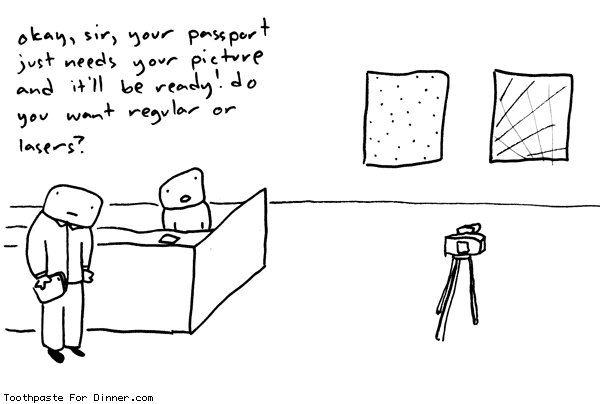
I can't believe I haven't posted this yet. I never had the laser background, myself (and I don't remember even having the option at my school) though I am sure that some of my dorky outfits/haircuts could compete with those on this page.
Some things that I saw, heard, felt, went to, or did recently (and maybe you should check out, too)
Victoire has put out an EP (A Door Into the Dark) over at eMusic. You can only get it at eMusic for now. Their review: The band's combination of chittering electronics, found sound and repetitive string and woodwind lines eloquently conjures how it feels to helplessly grope for words that don't exist to describe disquiet we can't place, how it feels to be left alone with only the colors of our own thoughts for company. ......................................................... Gomorrah, a new film (in the U.S. at least) by Matteo Garrone. This is playing at the IFC Center in New York. I think its been a hit there, so it may play in other cities. As well it should.
It is worth watching the film just to see some of the settings (like the ruined concrete ziggurat-like housing projects) and puzzle over them (there were so many times when I was pleasantly at a loss to grasp what was happening in the background of some scenes).
Go and see it if you can. If you need more prodding, here is the review that tipped me off to the film in the first place.
......................................................... David Byrne at Radio City Music Hall. I thought it was great: he's still got it, and Radio City is an incredible space (I am a sucker for red velvet walls and gold trim, and I don't like using "restrooms" - I prefer "Lounges").